B2G competitive intelligence: how to research incumbents and time rip-and-replace campaigns
Find the incumbent vendor in a government or education account, pull contract terms from public records, and time displacement outreach to the renewal window.

Most B2G sales teams can name their competitors but cannot say which of those competitors holds which account in their TAM.
In government and education, that answer is hiding in plain sight. Contract awards, purchase orders, and board agendas identify the incumbent, the amount paid, and the date the current agreement ends.
This guide explains how to pull those records account by account, review them for renewal timing, and turn them into a territory map your reps can act on.
What is B2G competitive intelligence?
B2G competitive intelligence is the practice of using public procurement and governing body records to learn which vendor currently holds a government or education account, what that vendor is paid, when the current agreement ends, and how the buyer scored the last award. The practice produces a documented competitive position for a named account rather than a market overview.
A rep who has done that research walks into the first call already knowing which vendor they are displacing and when the buyer will decide whether to keep that vendor.
How B2G competitive intelligence differs from commercial competitive intelligence
Incumbency, awarded pricing, contract end dates, and evaluation criteria are public records in government and education, while the same facts stay private in commercial deals.
A commercial competitive intelligence program has to infer each of them:
- Sellers watch job postings for a competitor’s tooling and read review sites for complaints.
- They buy install data and reconstruct a renewal date from what a champion mentions on a call.
Government and education buyers create those same facts as documents because they spend appropriated money and answer to a governing body.
- A city council votes to award a contract in an open meeting, and the vote appears on a posted agenda.
- A school district issues a purchase order under a contract it awarded, and the payment appears in a vendor register.
When a contract term ends, the council or board votes again.
Commercial and B2G reps therefore start their research in different places:
- A commercial rep begins with a hypothesis about the incumbent and tests it during discovery. A B2G rep begins with the award document and asks the buyer about its terms.
- Competitive research in government and education is mostly a matter of knowing which document holds each fact and where the agency posts that document.
Identifying the incumbent vendor and pulling contract terms from public records
The incumbent’s name and contract terms appear in award notices, purchase orders, and vendor payment registers. Budget line items and board or council approval items include the same details.
The easiest place to start is the agency’s own published records.
Most cities, counties, districts, and campuses post board and council agendas with attachments, and a contract award or renewal usually arrives with an attached staff report naming the vendor, the amount, and the term.
What an award or purchase order tells you about renewal timing
Read the term structure of an award or a purchase order first.
Public contracts usually have a fixed base period followed by renewal periods the agency may choose to exercise.
The Maryland Procurement Manual defines an option as the state’s unilateral right to extend the contract for an additional period and requires that the exercise of an option be approved and awarded before the current term expires.
The base end date on the face of the award is therefore not the date the deal reopens. The date that matters is when the buyer must decide whether to exercise the next option.
Then read the contract modifications.
A contract modification is any written change to the specifications, delivery date, contract period, price, or quantity.
An amendment that changes the contract period is therefore the record of an extension, and it shifts the actual end date. A vendor register or purchase order history confirms whether payments are still being made against the award and at what rate.
How to scope a records request when the contract is not posted
Check what the agency has already published before creating a FOIA request.
American Oversight advises requesters to research government websites and public reporting first, identify the specific custodians likely to hold the records along with their offices and titles, and narrow the request to a defined time period.
If the contract is not already public, file a FOIA request under the agency’s applicable state open-records law.
In the request, name the specific records you want rather than asking the agency to answer a question.
A request for the executed contract, all modifications, and the most recent invoices under a specific award number moves faster than a request for everything the agency has on a vendor.
Maryland’s contract administration guidance describes a contract file that includes:
- The executed contract
- Task orders
- Correspondence
- Change orders and modifications
- Copies of invoices
Naming those documents tells the records officer exactly what to retrieve, and therefore significantly speeds up your FOIA request.
Include a fee limit and your contact information, then follow up after the agency’s response deadline passes.
Signs of dissatisfaction in board and council materials
Short-term extensions, reduced scope, and commissioned reviews indicate a buyer reconsidering its incumbent. So do recorded complaints and shifting budget lines.
Each of these dissatisfaction indicators appear in materials the board or council publishes before it votes.
- Routine contract renewals normally appear on a consent agenda, which a board approves in a single vote without discussion.
- Supporting materials for consent items are distributed to members in advance, and the minutes record the full text of what the board adopted.
If a renewal stays on the consent agenda year after year, the board is still treating the incumbent as routine rather than reconsidering the contract.
A renewal pulled from the consent agenda for discussion, tabled, or approved for a shorter term than the previous renewal tells you the board is no longer treating that vendor as routine.
Performance records can reveal dissatisfaction that never appears in a public board discussion.
For example, Maryland’s contract administration guidance allows a contract monitor to request a corrective action plan when a contractor is not meeting its obligations. An agency may also require corrective action before imposing liquidated damages.
A corrective action plan therefore gives you a concrete signal: the agency has documented a performance problem with the incumbent, along with when that problem occurred.
Budget changes can reveal the same reassessment.
If spending on the incumbent’s product or service shrinks, moves to another department, or is replaced by funding for a study or evaluation, the agency may be reconsidering the current approach rather than preparing for a routine renewal.
Mapping which competitor holds which accounts in your territory
A territory map turns account-level research into something a sales team can act on.
Each row represents an account. Each column captures one fact needed to judge whether that account is a realistic displacement opportunity.
Researching a single account tells you who the incumbent is and when the contract may come back into play. The territory map answers the broader question: Which displacement opportunities should the team work this quarter, and who owns each one?
Track these fields for every account:
- The incumbent vendor and the award or purchase order number
- The contract value and the unit pricing where the award shows it
- The base end date and the next option decision date
- The purchasing path the agency used last time, such as a competitive solicitation or a cooperative contract
- Any dissatisfaction evidence, with the meeting date and document it came from
- The date you last verified the row
Sort the territory map by option decision date to create a working displacement calendar.
Sort the territory map by incumbent vendor to see which competitors hold the most accounts across your territory.
The hard part is keeping the territory map up to date.
A territory with a few hundred accounts means a few hundred rows, and every row goes stale the moment a board meets or an amendment is signed.
Refreshing those rows by hand is the work that may never get done.
If you want to automate the manual lead research process, consider Starbridge.
Starbridge is the AI GTM platform for companies selling to the government, K-12, and higher education, helping teams prioritize the right accounts, engage the right people earlier, and identify high-intent opportunities before the competition.
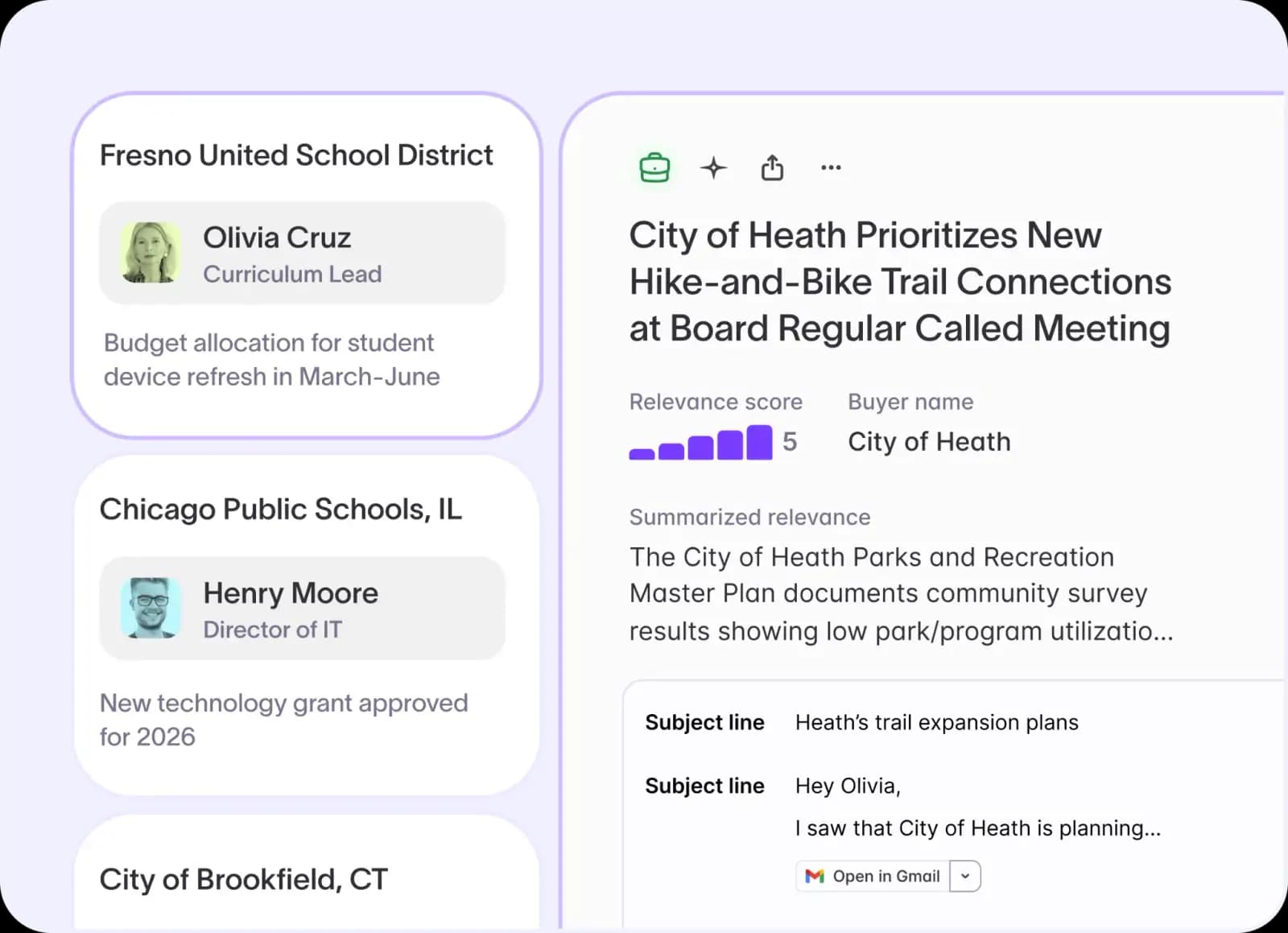
Instead of refreshing rows by hand, reps receive up-to-date contract and renewal information pushed to them.
Public Spend Intelligence surfaces purchase data, full competitor contracts, and unredacted vendor proposals obtained directly from agencies, and territory alerts deliver renewal timing to the rep who owns the account.
GovWell uses territory-based alerts, incumbent vendor tracking, and renewal timeline monitoring, and sources 15% of its total qualified pipeline from Starbridge.
When should you start displacement outreach before a renewal?
Start before the agency begins deciding whether to renew the incumbent, not when the current contract expires.
Maryland’s procurement guidance explicitly states that an option must be approved and awarded before the current term ends. When an agency may not exercise the option, the decision to re-procure must be made early enough to allow ample time to run a new solicitation.
The buyer therefore decides whether to renew or rebid well before the end date printed on the award.
That renewal-or-rebid decision is the date to work backward from.
The agency has to leave enough time for a solicitation, an evaluation, and an award, so the internal discussion about whether the incumbent stays begins well before the option decision itself.
A rep arriving after the agency has drafted requirements is arriving after the specification has been shaped.
For example, if the award shows a base term ending in June and two remaining one-year options, the account’s real decision window opens when staff begin preparing the renewal recommendation for the board, not in June.
Put that estimated decision window on the territory map and use it to time outreach.
When no contract end date is available, estimating the renewal window from purchase history becomes a separate research step. Among accounts already approaching a renewal decision, use evidence of incumbent dissatisfaction to decide which ones to prioritize.
Briefing a rep before the first call on a target account
A usable brief names the incumbent, the amount paid, the end date, the approving body, the evidence of public dissatisfaction, and the criteria the buyer used to score the last award.
Anything beyond that is context the rep will not use in the first ten minutes.
Then add what the expiring contract record alone cannot tell you:
- Name the staff member who will recommend the renewal to the board, because that person shapes the recommendation before anyone votes.
- Then write one question the rep should ask that only someone who read the file could ask.
That question is what separates a rep who read the file from a rep who read a summary.
Instead of asking a generic discovery question, a rep might ask how the shared services agreement has performed since the agency changed its scope last spring. The buyer immediately knows the rep understands the account.
The challenge is producing that level of preparation for every target account without asking reps to spend hours researching each one.
That’s one of the reasons we created Starbridge.
Buyer Profiles and Buyer Summary assemble cited account briefings from public spend, contract, and meeting records on demand, so a rep gets the competitive picture without spending the morning building it.

Susan Walters, Director of Revenue Intelligence at Frontline Education, says research that used to take two hours now takes five minutes, a 90% reduction in account research time that lets sellers hold pricing and competitive conversations instead of running discovery during the meeting.
Where to start
Start with one territory and one competitor.
Pull the award or purchase order for every account where that competitor is the incumbent, record the end date and the next option decision date, and note any board or council item that suggests the account is dissatisfied.
That process will usually produce a smaller target list, but a much more useful one.
Prioritize those accounts by decision date, not by where they happen to appear on a prospecting list.
The best displacement opportunities this quarter are the accounts where the buyer will soon decide whether to renew the incumbent and where the public record gives you a reason to believe the decision may be open.
If you want that territory map maintained automatically across your entire TAM, book a demo.
Frequently asked questions
B2G stands for business-to-government. It refers to companies that sell products or services to government buyers, including state agencies, cities, counties, school districts, and public colleges and universities.
Yes. Contracts, purchase orders, and meeting records held by government and education agencies are generally available to the public via FOIA requests, and agencies routinely process those requests. Ask for specific documents rather than information, and expect redactions for anything a vendor properly marked as proprietary.
Refresh according to the buyer’s calendar rather than a fixed interval.
Recheck an account when its board or council meets, when an amendment or renewal is approved, and in the quarter before its next option decision date. Everything else can wait for an annual sweep.
First look at the purchase order history, because a recurring annual amount usually indicates the renewal month. Then request the executed contract and all modifications, since an amendment often defines the term that the original award left open.
Revenue operations usually own the territory map and the refresh cadence. Sales leadership owns which accounts get worked and when. Marketing owns the positioning drawn from the evaluation criteria, and reps own the account details before each call.
Explore our use case library
 Automate account research with AI agentsStop manually researching accounts. Starbridge AI agents automate account research by monitoring buying signals 24/7 and surfacing the right contacts.
 Identify competitor contract expiration datesThe RFP is usually a formality. Starbridge surfaces competitor contract expiration dates so your reps reach accounts before the renewal cycle closes.
 Create a conference campaignTurn conference badge scans into pipeline. Import your contact list, surface buying signals across every account you met, and follow up with context.